Early bird discount announced for Udi Dahan’s Advanced SOA course
 We are announcing a 10% discount for early registration that goes to September 15th. Register before August 31, and you’ll receive 10% off the price.
You can also receive a volume discount for sending 3 or more people to the training (10%).
Sign up while the tickets are hot!
Advanced Distributed Systems Design using SOA & DDD with Udi Dahan, The Software Simplist
Monday, October 13, 2008 at 08:00 AM – Friday, October 17, 2008 at 05:00 PM (CT)
Austin, TX
 Introduction
Designing large-scale distributed systems is hard. New technologies make it easier to comply with today’s communications and security standards, but don’t auto-magically give you a robust and scalable system. Join Udi for a course packed with the wisdom of companies like SUN, Amazon, and EBay.
Tried-and-true theories and fallacies will be shown, keeping you from making those same costly mistakes today. Communications patterns like publish/subscribe and correlated one-way request/response will be used in conjunction with advanced object-oriented state management practices for long-running workflows. If you enjoy deep architectural discussion, if you are in charge of building a large-scale distributed system, if you want to know more about how the big guys run their systems, this is for you.
About Udi
Udi Dahan is The Software Simplist, recognized by Microsoft Corporation with the coveted Most Valuable Professional award for Solutions Architecture now 4 years running. Udi is a Connected Technologies Advisor working with Microsoft on WCF, WF, and Oslo. He also serves as a member of the Patterns & Practices Advisory Board for the CAB and Prism. He provides clients all over the world with training, mentoring and high-end architecture consulting services, specializing in Service-Oriented, scalable and secure .NET architecture design.
Udi is a member of the European Speakers Bureau of the International .NET Association, an author and trainer for the International Association of Software Architects and a founding member of its Architect Training Committee. He is also a Dr. Dobb’s sponsored expert on Web Services, SOA, & XML.
Presenting at international conferences like TechEd USA, SD Best Practices, DevTeach Canada, Prio Germany, Oredev Sweden, TechEd Barcelona, QCon London, and TechEd Israel – Udi covers in-depth mission-critical topics like durable services, persistent domain models, and multi-threaded occasionally connected clients.
Audience
This workshop is targeted at team leads, application and solutions architects, as well as technologists who are involved in making decisions about the overall system design of software products and projects.
Course Topics
Module 1: Distributed Systems Theory
Decades of distributed systems development have taught us many lessons. In this module we’ll cover many historical mistakes as well as proven best practices for scalable and robust design. Topics include:
• 8 fallacies of distributed systems
• Transactions
Module 2: Coupling: Platform, Temporal, & Spatial
Loose coupling has become the watchword of complex systems development, yet few understand its multiple dimensions. In the module we’ll be covering the three different dimensions of coupling as well as patterns for dealing with them.
• Platform Coupling – XML/SOAP
• Temporal Coupling – Synchronous/Asynchronous
• Spatial Coupling – Endpoints/Topics
Module 3: Asynchronous Messaging Patterns
Although scalability is achieved through the use of asynchronous message passing, more advanced message exchange patterns are required to handle today’s complex integration scenarios. This module will cover the most commonly used patterns:
• One way
• Correlated Request/Response
• Publish/Subscribe
Module 4: Bus & Broker Architectural Styles
Enterprise Service Buses are all the rage these days. In this module we’ll be covering what’s the difference between the Bus architectural style, and the more well-known Broker, found commonly in many EAI projects. Topics will include:
• Architectural advantages and disadvantages
• Technological advantages and disadvantages
Module 5: SOA Building Blocks
One of the goals of SOA is to develop systems which are more closely aligned with Business. In this module we’ll be covering an analysis methodology from moving from the business domain to executable systems that comply with all the principles of loose-coupling.
• Business Services
• Business Components
• Autonomous components & Queues
Module 6: Scalability and Flexibility
In order to enable agility, services must be able to scale up, out, and down quickly. In this module we’ll see how autonomous components can be configured including transactional and durable aspects of message handling.
• Configuring autonomous components
• Scaling up and out
Module 7: Long running processes
The distributed communications patterns wouldn’t be complete without a discussion on orchestration. In this module we’ll see how to manage the state of long-running distributed communication flows as well as:
• Encapsulating process logic
• Advantages & disadvantages of orchestration
Module 8: Service / Autonomous Component Solutions
As developers go to implement autonomous components, guidance is required as to which concepts need to implemented in which project, what dependencies are there between projects, and how to bridge the worlds of messaging, business logic, and reporting. Topics include:
• Messages + Handlers
• Databases
Module 9: Service Layer – Domain Model Interaction
Logic-rich services require the use of advanced techniques for logic componentization. The Domain Model Pattern enforces a high level of Separation of Concerns, yet it must eventually be connected with Service Layer code that supports many concurrent users. In this module, the topics covered will include:
• Domain Model introduction
• Testing Domain Models
• Optimistic, Pessimistic, and Realistic Concurrency Models
Module 10: Creating High-Performance Domain Models
The strong separation between the Domain Model and the database which stores and retrieves its data may enable a high level of testability, yet often causes performance problems. In this module, we’ll see the various aspects impacting the performance of persistence:
• Transactions and Isolation Levels
• Lazy Loading, Eager Fetching
• Databases Tips & Tricks
Module 11: Web Services and User Interfaces
The ease of interacting with users over the web drives the need for service to UI interactions. Also, many integrations require exposing synchronous web services to customers. In this module, we’ll see what is required in both cases:
• ASP.NET 2.0 Asynchronous Tasks
• Rich Internet Applications and Services
• Web Services for integration
Module 12: Smart Client / Service Interaction
The publish/subscribe semantics with which services communicate require smart clients to perform a great deal of background work. Also, certain service contracts lead to more performant clients. In this module, we’ll cover the first part of these interactions:
• Multi-threaded client challenges
• Client-friendly Service Contracts
• Service Agents and Client Repositories
Module 13: Notifications & Smart Clients
After Message Handlers in the Service Layer create or update the relevant Model objects in the client Repository, Supervising Controllers are in charge of getting Views to show the updated data. In this module, we’ll describe the parts and interactions of these flows:
• Client-side Model Objects
• Supervising Controllers
• Views and their Interfaces
Module 14: Commands & Smart Clients
Capturing user intent and synchronization between views are at the core of smart clients. After describing solutions that use Events on the View Interfaces, the Command Pattern will be introduced to further decrease coupling between Supervising Controllers. In this module, we’ll describe the parts and interactions of these flows:
• View Interfaces, and how Entity Cloning affects them
• Supervising Controllers and clone reconciliation
• Commands, and Event-Based programming
 ” The
” The 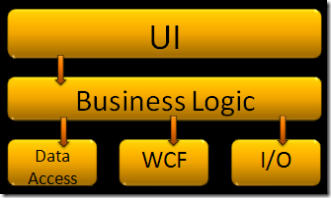 Let’s review. Traditional layered architecture can look somewhat like the diagram depicted on the right. Each layer communicates with the layer below it. The UI talks to business logic, but it does not talk directly to data access, WCF, etc. The layering approach does call out the need to keep certain categories of code out of the UI. The big downfall is that business logic ends up coupled to infrastructure concerns. Data Access, I/O, and Web Services are all infrastructure. Infrastructure is any code that is a commodity and does not give your application a competitive advantage. This code is most likely to change frequently as the application goes through years of maintenance. Web services are still fairly new, and the first version in .Net, ASMX, is already deprecated in favor of WCF. We can be assured that WCF’s days are numbered as well, so it is foolish to tightly couple the business logic to WCF. Data access changes every two years or so, so we definitely don’t want to be tightly coupled to it. For long-life, we would want our business logic to be independent of these infrastructure concerns so that as infrastructure changes, the business logic doesn’t have to.
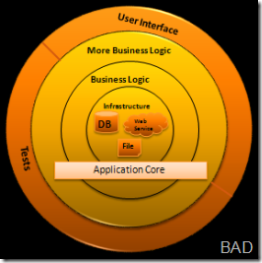
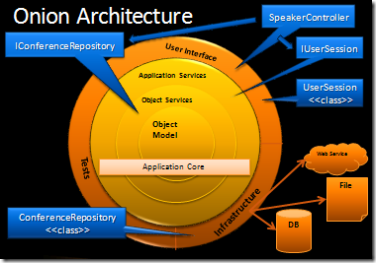 Let’s review Onion Architecture. The object model is in the center with supporting business logic around it. The direction of coupling is toward the center. The big difference is that any outer layer can directly call any inner layer. With traditionally layered architecture, a layer can only call the layer directly beneath it. This is one of the key points that makes Onion Architecture different from traditional layered architecture. Infrastructure is pushed out to the edges where no business logic code couples to it. The code that interacts with the database will implement interfaces in the application core. The application core is coupled to those interfaces but not the actual data access code. In this way, we can change code in any outer layer without affecting the application core. We include tests because any long-lived application needs tests. Tests sit at the outskirts because the application core doesn’t couple to them, but the tests are coupled to the application core. We could also have another layer of tests around the entire outside when we test the UI and infrastructure code.
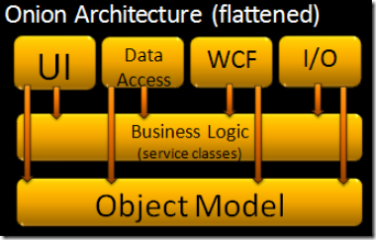 To the right, I have created a diagram which attempts to show what Onion Architecture would look like when represented as a traditionally layered architecture. The big difference is that Data Access is a top layer along with UI, I/O, etc. Another key difference is that the layers above can use any layer beneath them, not just the layer immediately beneath. Also, business logic is coupled to the object model but not to infrastructure.