I (Headspring) am hiring senior developers and principal developers immediately

There are lots of folks in the industry I’d love to work with.  If you’d like to work with me, let me know.  Headspring is growing quickly, and I need folks who are passionate about agile development with .Net.  All Headspring developers report directly to me.  We are serious about agile and serious about keeping good people.  Personality is just as important as software skill

Agile .NET Developers (senior and higher)

Headspring Systems seeks talented and exceptional Agile .NET Developers. Ideal development experience should include extensive object-oriented design and experience with extreme programming (XP), especially test-driven development. Experience with Scrum, NAnt and NHibernate is a plus.

    Job Responsibilities
  • Work face-to-face in Austin, TX on a high-speed agile engineering team using one-week iterations.
  • Serve as a technical lead/hands-on developer on project teams to develop and maintain applications that improve our clients’ businesses.
  • Participate in all activities of development including user story definition, estimation, automated testing, architecture, coding, and deployment.
  • Enhance existing automated processes to streamline unit testing, integration testing, database change management, and application deployment.
  • Troubleshoot system problems and provide timely resolutions.
  • Communicate release status and escalate issues to management.
  • Deliver high quality technical solutions in support of defined business objectives.
    Job Requirements
  • Bachelor’s in Computer Science or equivalent working experience
  • Minimum of 2 years experience in Microsoft technologies
  • Minimum 1 agile project completed or extensive personal study.
  • Experience delivering at least 2 solutions to production
  • Strong ability to analyze business requirements, formulate multiple implementation options, and effectively communicate these options to clients
  • Self-motivated – able to work cohesively in a small team environment
  • Continuous learner that constantly seeks to improve by such means as reading books and blogs and participating in the development community
  • 5+ years of experience with OO-based languages (C#.NET is ideal) and database management systems (SQL Server preferred) for senior developers; 2+ years of application development and maintenance experience in ASP.NET including delivery of full life-cycle applications and/or web development and maintenance experience for junior and mid-level developers

Headspring Culture
Our work environment is a relaxed one. Our office is open so it gets a little noisy at times but we like the energy this creates. We like to have fun, but we also work hard, we like to have a balanced work life. Excellent medical benefits are also offered. To learn more about our organization, please visit us at www.headspringsystems.com

To apply:
Please send your resume to our recruiter via email: jobs@headspringsystems.com
In your cover, please include your high/low salary requirements and please explain why this role seems like a good match for you. Qualified applicants will be responded to as quickly as possible and by me personally.

Early bird discount announced for Udi Dahan’s Advanced SOA course

We are announcing a 10% discount for early registration that goes to September 15th.  Register before August 31, and you’ll receive 10% off the price.

You can also receive a volume discount for sending 3 or more people to the training (10%).

Sign up while the tickets are hot!

Advanced Distributed Systems Design using SOA & DDD with Udi Dahan, The Software Simplist

Monday, October 13, 2008 at 08:00 AM – Friday, October 17, 2008 at 05:00 PM (CT)

Austin, TX   

Introduction
Designing large-scale distributed systems is hard. New technologies make it easier to comply with today’s communications and security standards, but don’t auto-magically give you a robust and scalable system. Join Udi for a course packed with the wisdom of companies like SUN, Amazon, and EBay.

Tried-and-true theories and fallacies will be shown, keeping you from making those same costly mistakes today. Communications patterns like publish/subscribe and correlated one-way request/response will be used in conjunction with advanced object-oriented state management practices for long-running workflows. If you enjoy deep architectural discussion, if you are in charge of building a large-scale distributed system, if you want to know more about how the big guys run their systems, this is for you.

About Udi
Udi Dahan is The Software Simplist, recognized by Microsoft Corporation with the coveted Most Valuable Professional award for Solutions Architecture now 4 years running. Udi is a Connected Technologies Advisor working with Microsoft on WCF, WF, and Oslo. He also serves as a member of the Patterns & Practices Advisory Board for the CAB and Prism. He provides clients all over the world with training, mentoring and high-end architecture consulting services, specializing in Service-Oriented, scalable and secure .NET architecture design.

Udi is a member of the European Speakers Bureau of the International .NET Association, an author and trainer for the International Association of Software Architects and a founding member of its Architect Training Committee. He is also a Dr. Dobb’s sponsored expert on Web Services, SOA, & XML.

Presenting at international conferences like TechEd USA, SD Best Practices, DevTeach Canada, Prio Germany, Oredev Sweden, TechEd Barcelona, QCon London, and TechEd Israel – Udi covers in-depth mission-critical topics like durable services, persistent domain models, and multi-threaded occasionally connected clients.

Audience
This workshop is targeted at team leads, application and solutions architects, as well as technologists who are involved in making decisions about the overall system design of software products and projects.

Course Topics

Module 1: Distributed Systems Theory
Decades of distributed systems development have taught us many lessons. In this module we’ll cover many historical mistakes as well as proven best practices for scalable and robust design. Topics include:
  • 8 fallacies of distributed systems
  • Transactions

Module 2: Coupling: Platform, Temporal, & Spatial
Loose coupling has become the watchword of complex systems development, yet few understand its multiple dimensions. In the module we’ll be covering the three different dimensions of coupling as well as patterns for dealing with them.
  • Platform Coupling – XML/SOAP
  • Temporal Coupling – Synchronous/Asynchronous
  • Spatial Coupling – Endpoints/Topics

Module 3: Asynchronous Messaging Patterns
Although scalability is achieved through the use of asynchronous message passing, more advanced message exchange patterns are required to handle today’s complex integration scenarios. This module will cover the most commonly used patterns:
  • One way
  • Correlated Request/Response
  • Publish/Subscribe

Module 4: Bus & Broker Architectural Styles
Enterprise Service Buses are all the rage these days. In this module we’ll be covering what’s the difference between the Bus architectural style, and the more well-known Broker, found commonly in many EAI projects. Topics will include:
  • Architectural advantages and disadvantages
  • Technological advantages and disadvantages

Module 5: SOA Building Blocks
One of the goals of SOA is to develop systems which are more closely aligned with Business. In this module we’ll be covering an analysis methodology from moving from the business domain to executable systems that comply with all the principles of loose-coupling.
  • Business Services
  • Business Components
  • Autonomous components & Queues

Module 6: Scalability and Flexibility
In order to enable agility, services must be able to scale up, out, and down quickly. In this module we’ll see how autonomous components can be configured including transactional and durable aspects of message handling.
  • Configuring autonomous components
  • Scaling up and out

Module 7: Long running processes
The distributed communications patterns wouldn’t be complete without a discussion on orchestration. In this module we’ll see how to manage the state of long-running distributed communication flows as well as:
  • Encapsulating process logic
  • Advantages & disadvantages of orchestration

Module 8: Service / Autonomous Component Solutions
As developers go to implement autonomous components, guidance is required as to which concepts need to implemented in which project, what dependencies are there between projects, and how to bridge the worlds of messaging, business logic, and reporting. Topics include:
  • Messages + Handlers
  • Databases

Module 9: Service Layer – Domain Model Interaction
Logic-rich services require the use of advanced techniques for logic componentization. The Domain Model Pattern enforces a high level of Separation of Concerns, yet it must eventually be connected with Service Layer code that supports many concurrent users. In this module, the topics covered will include:
  • Domain Model introduction
  • Testing Domain Models
  • Optimistic, Pessimistic, and Realistic Concurrency Models

Module 10: Creating High-Performance Domain Models
The strong separation between the Domain Model and the database which stores and retrieves its data may enable a high level of testability, yet often causes performance problems. In this module, we’ll see the various aspects impacting the performance of persistence:
  • Transactions and Isolation Levels
  • Lazy Loading, Eager Fetching
  • Databases Tips & Tricks

Module 11: Web Services and User Interfaces
The ease of interacting with users over the web drives the need for service to UI interactions. Also, many integrations require exposing synchronous web services to customers. In this module, we’ll see what is required in both cases:
  • ASP.NET 2.0 Asynchronous Tasks
  • Rich Internet Applications and Services
  • Web Services for integration

Module 12: Smart Client / Service Interaction
The publish/subscribe semantics with which services communicate require smart clients to perform a great deal of background work. Also, certain service contracts lead to more performant clients. In this module, we’ll cover the first part of these interactions:
  • Multi-threaded client challenges
  • Client-friendly Service Contracts
  • Service Agents and Client Repositories

Module 13: Notifications & Smart Clients
After Message Handlers in the Service Layer create or update the relevant Model objects in the client Repository, Supervising Controllers are in charge of getting Views to show the updated data. In this module, we’ll describe the parts and interactions of these flows:
  • Client-side Model Objects
  • Supervising Controllers
  • Views and their Interfaces

Module 14: Commands & Smart Clients
Capturing user intent and synchronization between views are at the core of smart clients. After describing solutions that use Events on the View Interfaces, the Command Pattern will be introduced to further decrease coupling between Supervising Controllers. In this module, we’ll describe the parts and interactions of these flows:
  • View Interfaces, and how Entity Cloning affects them
  • Supervising Controllers and clone reconciliation
  • Commands, and Event-Based programming

The Tarantino Project – automated database migrations and more

The Tarantino project is a collection of libraries and tools to facilitate change management and development

The Tarantino project contains a number of useful components for:

Tarantino is currently being developed and extended.  If you would like to contribute, the most welcome patch would be Oracle support for the database migrations.  Currenlty, only SQL Server is supported.

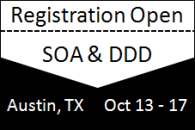
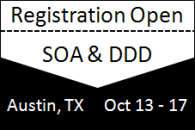
Udi Dahan to teach an SOA course in Austin, TX (October 13th) – sign up now

Headspring Systems is proud to host Udi Dahan in Austin, TX as he teaches his Advanced Distributed Systems Design using SOA & DDD course.  It will be a full week of advanced SOA goodness.  Go to the course page for all the details as well as the curriculum outline.

eventbrite_event = “158018638”;
eventbrite_view = “tickets”;
eventbrite_width = “600”;
eventbrite_height = “300”;
http://www.eventbrite.com/static/js/events.js

Inversion of Control is NOT about testability

Many times, I’ve heard that the best thing about IoC is that it enables testability.  When dependencies are injected into a class, it’s easy to test that class.  Testability is a side-effect of good design.  The lack of testability signifies a bad design, but the enable to test a class does not, by itself, signify a good design.  The causality is one-way.

Let’s take a look at an example:

public class MissileLauncher{
    private INavigator _navigator;
    public MissileLauncher(){
        _navigator = new MissileNavigator();
    }
    public void Launch(){
        //get direction guidance from _navigator and launch a missile
    }
}

This can be a good design or bad design depending on your needs.  We are coupling to an interface, INavigator, but we are also coupling to a specific implementation class, MissileNavigator.

If MissileLauncher can’t do its job without MissileNavigator, then this coupling makes sense, and the class should be tested together with MissileNavigator.  Other examples are operations on domain objects:  The logic makes no sense without the Customer object, specifically, so the operation should be tested with the real Customer, and not a mock object.

If, however, MissileLauncher is a concept orthogonal to MissileNavigator, then INavigator adequately illustrates the necessary interaction.  In this case, coupling to MissileNavigator is detrimental to our design if the MissileLauncher only depends on the operation exposed by INavigator.

We would change this class to the following:

public class MissileLauncher{
    private INavigator _navigator;
    public MissileLauncher(INavigator navigator){
        _navigator = navigator;
    }
    public void Launch(){
        //get direction guidance from _navigator and launch a missile
    }
}

Here, we have inverted the control over locating or creating the dependency.  Now MissileLauncher does not care about the actual class, just that it receives an instance of the interface.  With the interface it can do its job.  This is a better design if you have determined MissileLauncher’s behavior is orthogonal to the actual MissleNavigator class.  Again, you have to make many hard decisions about design.  Do you couple. . . or not. 

In order to do anything useful in software, you must couple.  You must couple to something. 

The coupling determines how you will test.  If you couple to a concrete class, you will test the code together with that class.  If you only couple to an interface, you can test the class with only the interface.

Testability is a by-product of inversion of control, and design is the driving factor to invert the control or retain it.  Don’t invert all control just so each class can be tested independently of all other classes.  You must decide where coupling is appropriate and where it is not.

ASP.NET MVC INETA tour in full swing – come see me speak

Last night I spoke in Austin, TX at the Austin .Net User Group, which is the user group I’ve been leading since 2005.  It was the first of 4 user group talks this week.  I’m taking one of my Tech Ed 2008 talks out on an INETA tour.  I’m representing the INETA speakers bureau and visiting Austin, Wisconsin, North Carolina, and Arkansas.

My topic is as follows. If you are in any of these cities, come on out to the local .Net User Group.

TDD, DI, and SoC with ASP.NET MVC

Spelled out, it is test-driven development, dependency injection, and separation of concerns with Active Server Pages .Net Model View Controller. This talk will dive into how to design a presentation layer using ASP.NET MVC. In today’s industry, TDD, DI, and SoC are proven concepts that lead to more maintainable applications. Along with demonstrating how to use these techniques with ASP.NET MVC, we will discuss just what concerns should be separated. This talk provides a unique perspective on separation of concerns and uses TDD and DI to make it happen. MvcContrib is used in all the demos.

About Jeffrey Palermo
Jeffrey Palermo is a software management consultant and the CTO of Headspring Systems in Austin, TX. Jeffrey specializes in Agile coaching and helps companies double the productivity of software teams. Jeffrey is an MCSD.Net , Microsoft MVP, Certified Scrummaster, Austin .Net User Group leader, AgileAustin board member, INETA speaker, INETA Membership Mentor, Christian, husband, father, motorcyclist, Eagle Scout, U.S. Army Veteran, and Texas A&M University graduate. Subscribe to Jeffrey’s blog feed here: http://feeds.jeffreypalermo.com/jeffreypalermo

Vote for your SXSW ’09 sessions now

South by Southwest (SXSW) is set for March 13-17, 2009 in Austin, TX.  From the website:

” The SXSW INTERACTIVE FESTIVAL celebrates the creativity and passion behind the coolest new media technologies. In addition to panel sessions that cover everything from web design to bootstrapping to social networks, attendees make new business connections at the three-day Trade Show & Exhibition. The newest element of the event is ScreenBurn, which adds specific gaming industry programming as well as a three-day Arcade to the mix.”

Voting has begun for the sessions that have been submitted for the conference.  I submitted a session entitled Managing High-Performing Agile Teams.  SXSW has a community voting process, so you can go online and vote for the sessions you would like to see at the conference.

Looking to hire a software tester immediately

I am hiring for the following position.  This person will report directly to me and work on a team that I am coaching.  If interested, you are applying to be on an extreme programming team.  We are very heavy into automation and frictionless development and deployments. 

—————————————–

Headspring Systems is looking for a talented and exceptional Agile Software Tester. Ideal experience should include extensive test automation and experience with extreme programming (XP).  Browser testing such as Watir or Selenium is desired.

Job Responsibilities

  • Work face-to-face in Austin, TX on a high-speed agile engineering team using one-week iterations.
  • Participate in all activities of development including user story definition, estimation, automated testing, and deployment.
  • Enhance existing automated processes to streamline unit testing, integration testing, database change management, and application deployment.

Job Requirements

  • Bachelor’s in Computer Science or equivalent working experience
  • Minimum of 2 years experience in Microsoft technologies
  • Minimum 1 agile project completed or extensive personal study.
  • Strong ability to analyze business requirements, formulate multiple testing options, and effectively communicate these options to clients
  • Self-motivated – able to work cohesively in a team environment and motivate the team
  • Continuous learner that constantly seeks to improve by such means as reading books and blogs and participating in the development community

Headspring Culture
Our work environment is a relaxed one. Our office is open so it gets a little noisy at times but we like the energy this creates. We like to have fun, but we also work hard, we like to have a balanced work life. Excellent medical benefits are also offered. To learn more about our organization, please visit us at www.headspringsystems.com

To apply:
Please send your resume via email: jobs@headspringsystems.com

In your cover, please include your high/low salary requirements and please explain why this role seems like a good match for you.